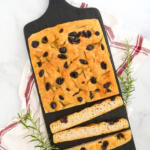
Rosemary focaccia
Easy overnight, no knead rosemary focaccia recipe.
Servings: 12 people
Calories: 207kcal
Equipment
- digital scale This is the one that I own and use daily!
Ingredients
- 500 grams all-purpose flour roughly 4 cups
- 8 grams kosher salt 2 tsp. *see notes
- 7 grams instant yeast 1/4 oz. packet
- 500 ml room temperature water 2 cups
- 2 oz. olive oil 4 tbsp., divided
- 2 tbsp. fresh rosemary leaves only
- 70 grams black olives roughly chopped, 1/2 cup *I used oil-cured
Instructions
- In a large mixing bowl, whisk together the flour, salt, and instant yeast. Pour in the water, and mix, using a sturdy rubber spatula, until you have a tacky ball of dough. Scrape the sides down to make sure everything is fully mixed in. *It will be sticky, resist the urge to add flour.
- Slick the surface of the dough ball with olive oil, then cover the bowl tightly with plastic wrap, or a tight-fitting lid. Place your oil-coated, tightly sealed ball of dough in the refrigerator overnight (or minimum of 12 hours). This will begin the slow fermentation process.

- Remove the dough from the fridge.Line a 9x13 baking pan with parchment paper. Pour half of the olive oil into the bottom of the prepared pan and swirl to coat the bottom.

- Using a flexible bench scraper, coax the dough out of the bowl. You can also use a rubber spatula if you don't have a bench scraper. *Run the bench scraper down the side of the bowl, turning the bowl each time you do this, until you've gone all the way around, and the dough is now in a rough ball.Tip the dough out of the bowl and into the prepared 9x13 pan. Turn the dough to coat in oil.

- Let the dough rise for 3 - 4 hours, uncovered, at room temperature. When the dough is puffy and has doubled in size, preheat oven to 425°F // 220°C.

- Pour remaining olive oil over the dough. Sprinkle rosemary leaves and black olives over the dough. Coat your three middle fingers in olive oil, then press straight down into the dough, all the way to the bottom of the pan, to create dimples all over. *You don't have to dimple every inch, just enough to make some pockets in the dough.

- Bake for 25 - 30 minutes, until golden brown. Remove from the pan, and place on a cooling rack. Let the rosemary focaccia cool for 20 minutes before slicing.If you plan to use it for sandwiches, let it cool completely before slicing in half lengthwise.

Notes
A note about salt - I use Diamond Crystal kosher salt. If you use Morton's kosher salt, or a fine kosher salt, reduce the amount of salt in the recipe. Diamond Crystal flakes are much different and they weigh significantly less. One teaspoon of Diamond Crystal salt weighs 3'ish grams, whereas a teaspoon of Morton's weighs 5 grams - almost double. If you are concerned about your focaccia being too salty, reduce the amount of salt to 1 1/2 tsp.
A note on yeast - You can use active dry yeast, if that's what you have. You'll need to let the yeast bloom in water for 15 minutes or so before moving on with the recipe.
Nutrition
Calories: 207kcal | Carbohydrates: 33g | Protein: 5g | Fat: 6g | Saturated Fat: 1g | Polyunsaturated Fat: 1g | Monounsaturated Fat: 4g | Sodium: 418mg | Potassium: 69mg | Fiber: 2g | Sugar: 0.1g | Vitamin A: 95IU | Vitamin C: 1mg | Calcium: 19mg | Iron: 2mg